Choosing a knitwear manufacturer
How to Find and Choose a Knitwear Manufacturer.
A practical guide from our sales desk: where to find knitwear manufacturers, what experienced buyers ask to see before the first sample, two costly mistakes we have seen, and how to run a video factory audit that actually tells you something.
 By Marcia Lee, Business Manager at Knitwear World · Updated October 2026
Where to look
Where to find knitwear manufacturers.
Most buyers build a shortlist from a mix of six channels. Each one gives you a different kind of supplier.
| Channel | Good for | Watch out for |
|---|---|---|
| Trade fairs | Seeing samples and meeting the team in person. Knitwear suppliers exhibit at the Canton Fair in Guangzhou, Texworld Apparel Sourcing in Paris, MAGIC in Las Vegas, AFF in Japan and Preview in Seoul; we have exhibited at all five. | Some stands belong to trading companies; ask where production takes place |
| Search engines | Finding specialists, when you search for the product, technique and country together, for example “jacquard sweater manufacturer China” | Check that the website shows its own machines, address and audits |
| B2B marketplaces | A wide choice of suppliers and quick quotes on platforms such as Alibaba, Made-in-China and Global Sources | Many listings are traders; verify the factory behind the listing |
| Directories | Makers by country and category: Maker’s Row for US manufacturers, Sewport by country, Kompass and Europages for European suppliers | Profiles vary in depth and are not always up to date |
| Referrals | Suppliers that other brands already trust, through LinkedIn, founder groups and industry associations | A good fit for one brand may not suit your product or quantities |
| Knitwear clusters | Going to where knitwear is made, such as Dongguan in Guangdong or Jiaxing in Zhejiang | Plan visits ahead; see our guide to sweater manufacturers in China |
Narrow the list to three to five suppliers and send each one the same brief: the same tech pack or reference, the same quantity per colour and the same delivery date. That makes quotes and samples comparable. The rest of this guide shows how to choose between them.
What buyers ask for first
What experienced buyers ask to see first.
When a new buyer contacts us, price is rarely the first question. Professional buyers want evidence before they invest time in sampling, and three things come up almost every time.
- Audit reports. Social compliance reports such as amfori BSCI, or a retailer’s own factory audit. Ours is an amfori BSCI audit conducted by TÜV Rheinland in 2026. Large retailers may also ask for a capacity overview, the quality-control procedure and photos of bulk production in the same product category.
- Physical samples. Not just one finished garment. Experienced buyers ask for a washed sample, a sealed jacquard swatch and yarn colour cards, so they can check colour, shape after washing and the back of patterned knits.
- A factory audit, on video or on site. They want to see real production, not a showroom.
Two more checks are worth adding: confirm the legal company behind the brand name you are talking to, and ask how the supplier’s machine capacity and order book fit your delivery window.
A real example
A women’s wear brand from Australia came to us to develop jacquard sweaters in a cashmere blend. Before discussing price, they asked for our audit report and three reference samples: a double jacquard with a birdseye back, an intarsia piece and a plain knit. Then they booked a one-hour video audit and walked through the knitting floor, the machines, the inspection tables and the warehouse.
Only after that did they ask for a first sample. When the sample was approved, they also had us seal a knitted swatch, which became the reference for colour and pattern in bulk. Without those materials, they would not have started sampling at all.
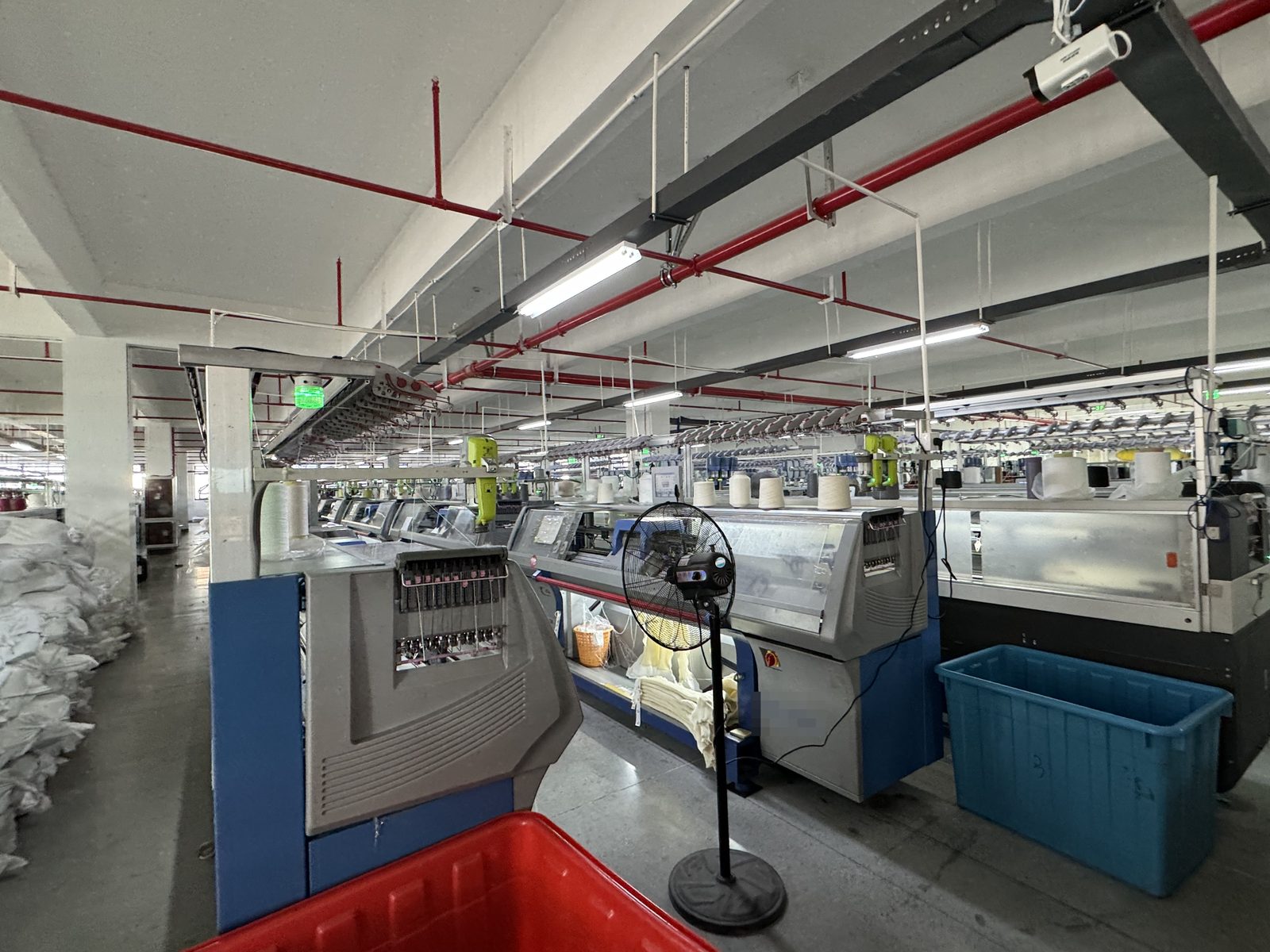
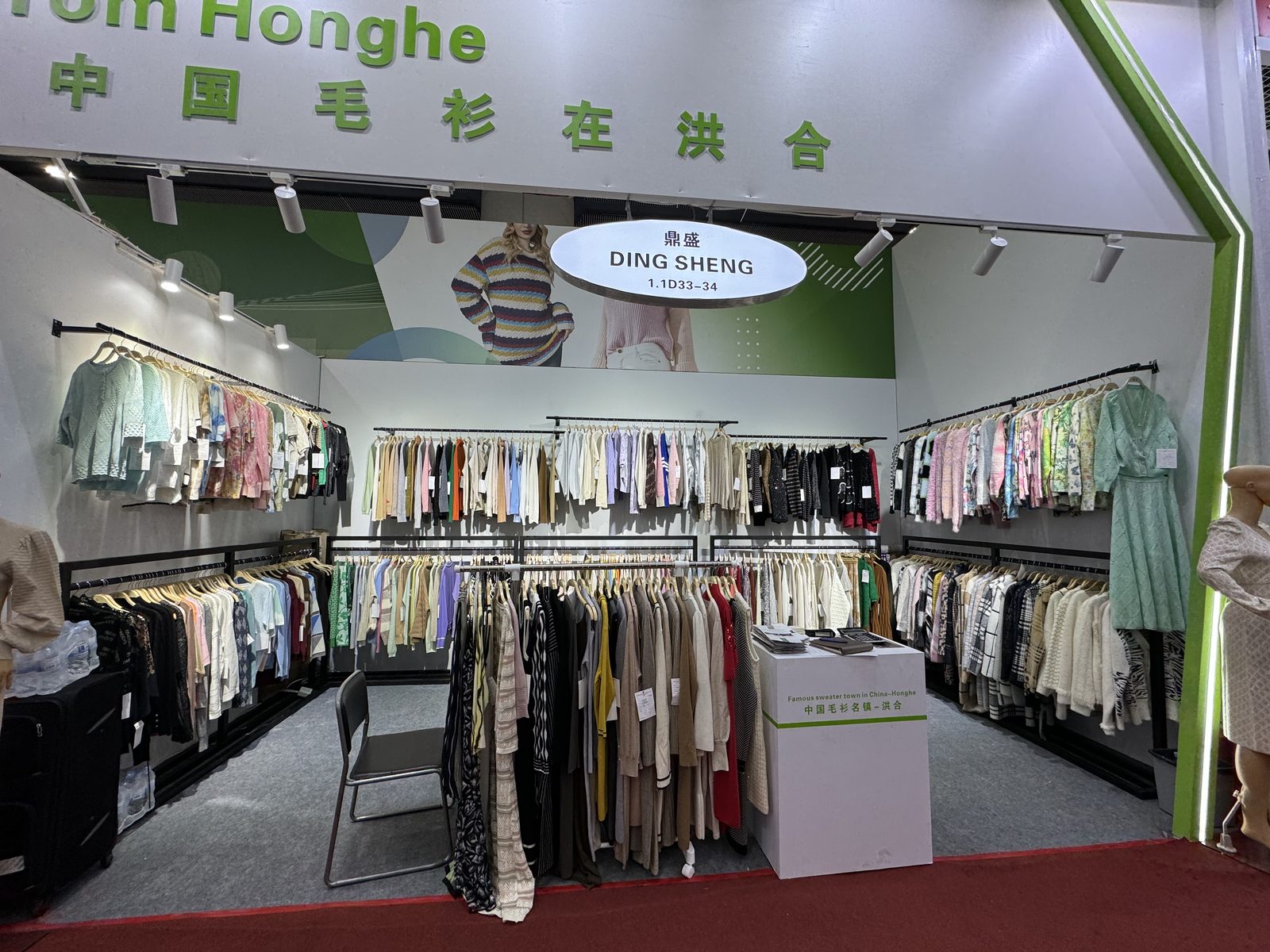
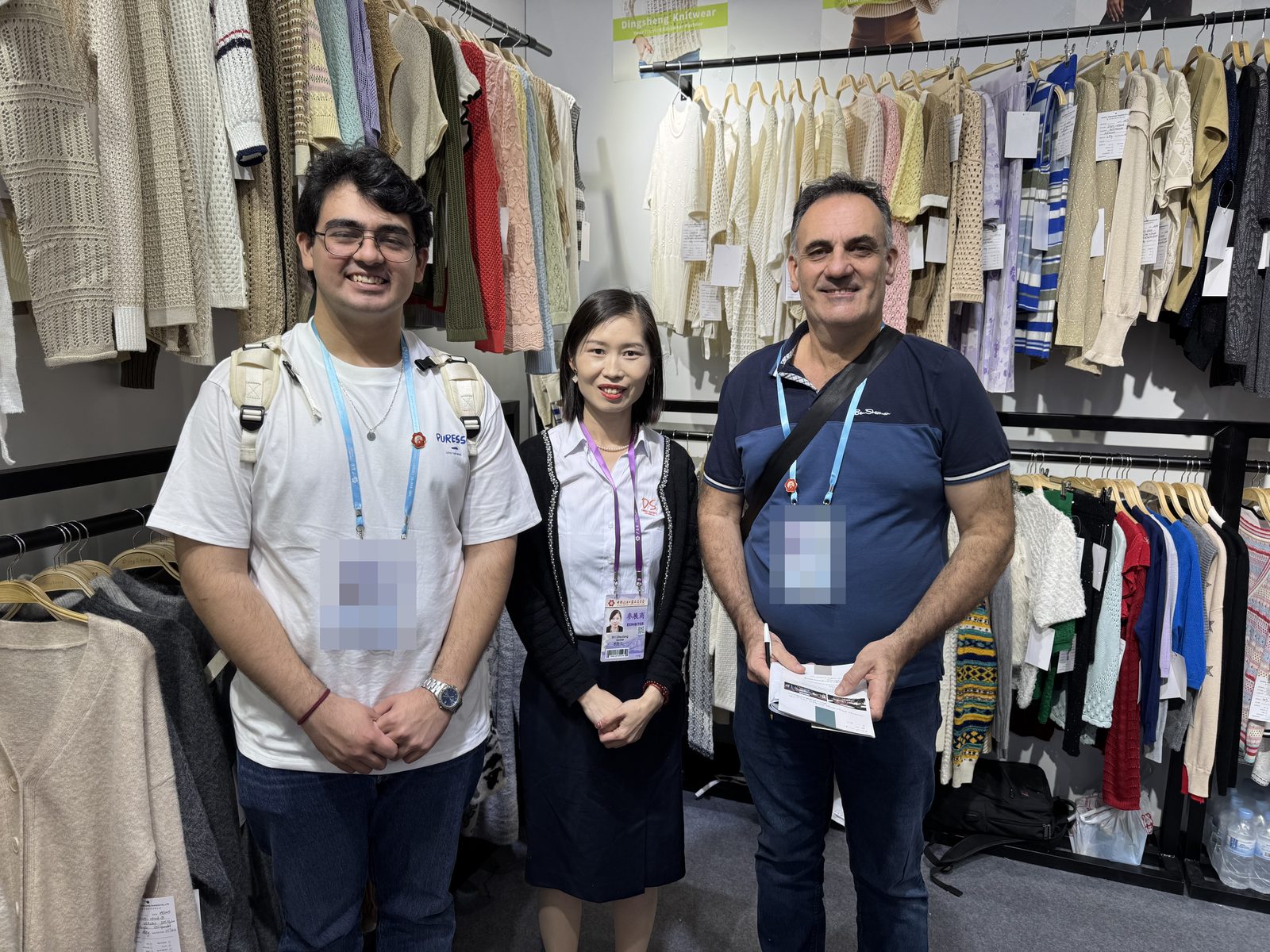
Our knitting floor in Jiaxing, our stand at the Canton Fair, and Marcia Lee with buyers at the fair. We welcome factory visits and video calls.
Learn from other buyers
Two costly mistakes we have seen.
Both situations were shared with us by buyers who had worked with other suppliers. Details are anonymized.
1. Colour differences and twisted checks after washing
A buyer ordered a three-colour double jacquard sweater from a small workshop. The sample colours looked right, but no yarn colour card was sealed; approval was based on the finished garment alone. In bulk, yarn from different dye lots showed clear colour differences. The coloured yarns also shrank at different rates, so after washing the checks twisted, motifs moved and the pattern no longer matched between front and back. The order could not be shipped as agreed and had to be sold at a discount.
What would have prevented it:
- Seal yarn colour cards and lab dips, not only the garment
- Approve a washed sample as well as the first sample
- Test shrinkage for each yarn colour in a jacquard
- Check pattern matching at the seams before bulk starts
2. A construction swapped to save time and money
A buyer ordered a double jacquard with a birdseye back. The supplier had quoted low and, to save cost and meet the deadline, quietly knitted the bulk as single jacquard with floats on the back. The buyer checked only the front of the pattern. The problem surfaced at the retailer’s inspection overseas: the long floats snagged easily and scratched the skin. The shipment was rejected, leaving the buyer with high freight costs and contract penalties.
What would have prevented it:
- Write the construction on the tech sheet and in the contract
- Keep a sealed swatch of the approved construction
- Check the inside of garments at pre-shipment inspection
- Use an independent inspection company such as SGS, QIMA or your own agency
Video factory audit
How to run a video factory audit.
A good video audit takes about an hour and shows real work in progress. We ask buyers to book one to two days ahead, so the call can avoid shift changes, meal breaks and machine maintenance and take place during normal daytime production. This is the route we follow:
- Sample room. Past samples in similar styles, yarn colour cards, certificates and sealed sample cards.
- Knitting floor. Computerized flat knitting machines in production, technicians setting up programs, and jacquard swatches being knitted. Ask to see the back of the fabric and how floats are handled.
- Finishing. Linking, sewing, pressing and the washing room. Many shrinkage problems start here.
- Quality control. Inspectors checking for dropped stitches, wrong stitches, measurements, colour differences and pilling.
- Trims and warehouses. Yarn storage, hangtags, main and care labels, and the packing and shipping area.
- Close-up. A knitted panel or half-finished garment from a running order, shown live on camera.
Tip: a supplier that only shows clean, empty corners is a warning sign. Ask to see orders that are actually in production.
Red flags
Six warning signs before you place bulk.
Most sourcing problems are visible before production starts, if you know where to look.
- Bulk is subcontracted. Samples are made in-house, but bulk goes to a smaller workshop with different quality control. Ask where bulk will be knitted, linked and finished, and put it in the contract.
- Construction changes after approval. A cheaper construction replaces the approved one, for example a double jacquard knitted as single jacquard. Compare the inside of bulk garments with the approved sample.
- Approval on looks only. A first sample can look right and still shrink or twist after washing. Approve a washed sample as well.
- Specifications agreed verbally. Construction, float tacking, tolerances and finishing belong on the tech sheet, not only in a chat.
- No colour standard. Without lab dips on the actual yarn and an agreed colour tolerance, colour disputes are hard to settle.
- Pattern ownership is unclear. Agree who owns your artwork and machine program, and whether the supplier may offer the design to others.
For patterned knits, see our jacquard guide for colour limits and a sampling checklist.
Factory review checklist
Five conversations before you commit.
Product
Show a comparable construction.
Sampling
Clarify timing, fees and revision rules.
Quality
Define approvals and inspection points.
Commercial
Align MOQ, payment and trade terms.
Delivery
Confirm the production trigger and plan.
Knitwear World example
Facts a buyer can verify with us.
Our current working baseline is 30 years in knitwear, 200 machines, 3GG–16GG capability, 2 million pieces annual capacity and a BSCI-audited facility.
Keep reading
Related guides.
- Knitwear development and production process
- OEM vs ODM knitwear: which route fits your brand?
- Knitwear MOQ explained
- How to choose the best yarn for sweaters
- How jacquard sweaters are made
- Knitwear quality control: what to check from yarn to shipment
- Sourcing knitwear at the Canton Fair: a buyer’s guide
- Our knitwear factory in Jiaxing
Start a project