Sourcing guide
Sweater Manufacturers in China: Regions, Factory Types and How to Choose.
China makes sweaters at every level, from high-volume basics to fine cashmere. This guide explains where China’s knitwear clusters are, which kinds of sweater factories you will meet, how China compares with other sourcing countries and how to shortlist a manufacturer, whether you are looking for a specialist sweater factory or a general clothing manufacturer in China. We write it from inside one of those clusters: our factory is in Honghe, Jiaxing.
 By Marcia Lee, Business Manager at Knitwear World · Updated October 2026
At a glance
Four knitwear clusters to know.
Most sweaters made in China come from a handful of towns where yarn suppliers, knitting factories, linking and finishing workshops, trim suppliers and wholesale markets sit within a short drive of each other. Each cluster has its own strengths.
| Cluster | Where | Known for | Scale (published figures) |
|---|---|---|---|
| Dalang | Dongguan, Guangdong | Fashion knitwear, fast design and development, whole-garment knitting | About 900 million sweaters a year |
| Honghe | Jiaxing, Zhejiang | Sweater factories and markets serving export and domestic buyers | Over 400 million sweaters a year |
| Puyuan | Tongxiang, Jiaxing, Zhejiang | China’s largest sweater distribution centre and wholesale market | More than 13,000 stores selling sweaters |
| Qinghe | Xingtai, Hebei | Cashmere dehairing, spinning and knitting | About 60% of China’s cashmere processing |
Figures as reported by China Daily, People’s Daily Online and Xinhua; see the sources at the end of this guide.
Guangdong
Dalang: fashion knitwear in the Pearl River Delta.
Dalang, a town in Dongguan between Guangzhou and Shenzhen, is often called China’s knitwear capital. Its first wool sweater factory opened in 1979, and the town now produces about 900 million sweaters a year, according to China Daily. The cluster covers design, development, knitting and marketing, and it has moved quickly into computerized and whole-garment knitting: China Daily reports that around 80 percent of Dalang’s whole-garment machines are now made in China.
Dalang suits buyers who want fashion-led styles and quick development close to the ports of Shenzhen and Hong Kong. The town also has large yarn and knitwear markets, so factories can sample in a wide choice of stock yarns.
Zhejiang
Jiaxing: Honghe and Puyuan, between Shanghai and Hangzhou.
Jiaxing in northern Zhejiang is home to two of China’s best-known sweater towns, both within easy reach of the ports of Shanghai and Ningbo.
Honghe
Honghe’s sweater industry began in the mid-1970s with a commune-run knitting factory. Today the town produces more than 400 million sweaters a year, with an annual turnover of over 20 billion yuan, according to People’s Daily Online. A local trading platform links eight sweater markets, ten industrial parks and more than 2,000 enterprises. Honghe factories range from small workshops to companies running hundreds of computerized flat knitting machines, and many export, with long-standing buyers from the Middle East to South America.
Puyuan
Puyuan, in Tongxiang, has been China’s largest sweater distribution centre since 1976, China Daily reports, with more than 13,000 stores selling sweaters and an industry turnover of over 100 billion yuan. Puyuan is mainly a wholesale market: it is the place to see what is selling and to buy ready stock, while custom development is usually done by factories rather than market stalls.
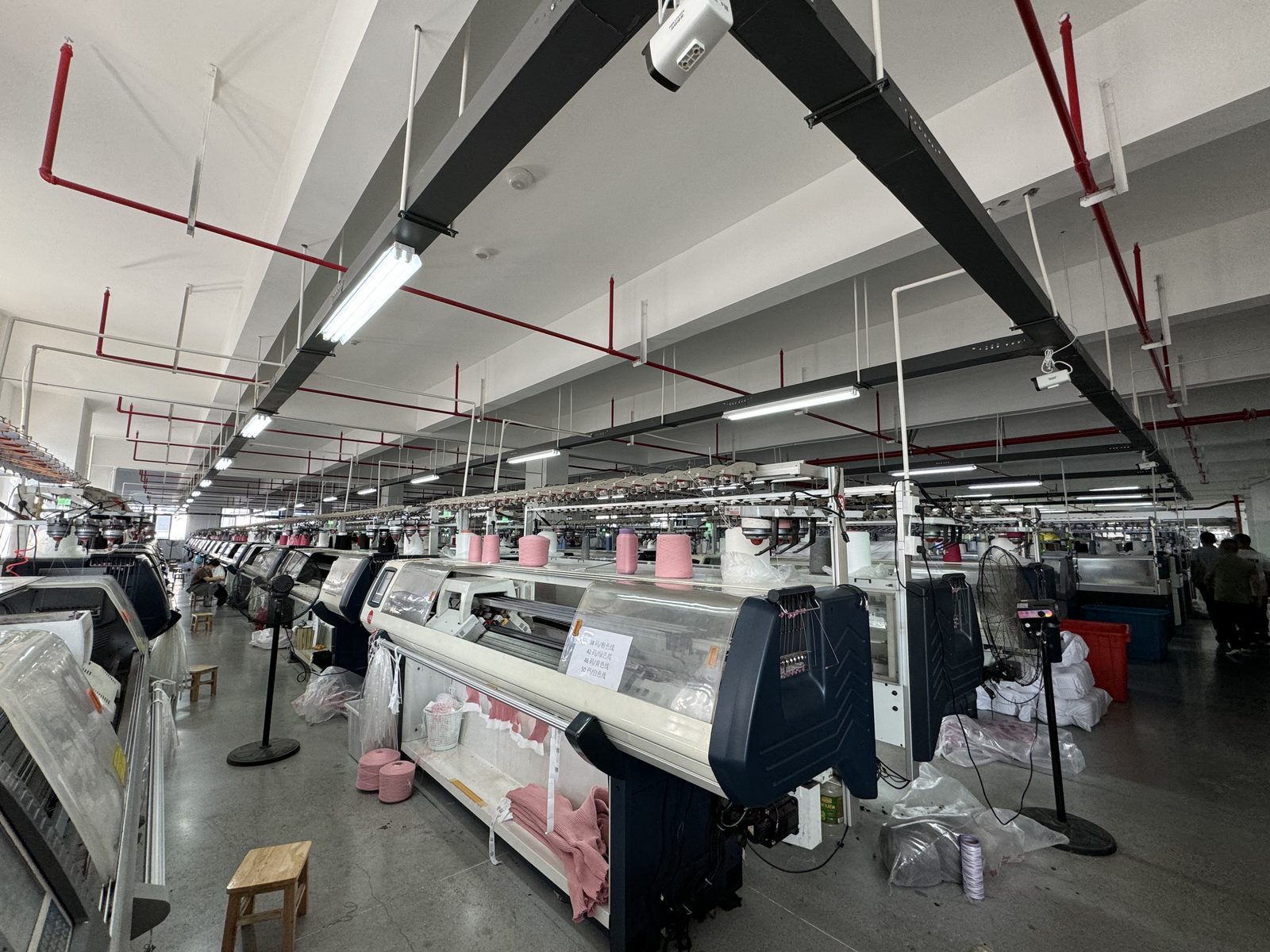
Our own factory is in Honghe. Working inside a cluster means yarn, trims, linking capacity and finishing services are close at hand, which shortens sampling and keeps bulk on schedule. See inside our factory.
Cashmere
Qinghe: China’s cashmere county.
Qinghe County in Hebei processes about 8,000 tonnes of cashmere a year, around 60 percent of China’s total, and has more than 1,700 cashmere-related businesses, according to Xinhua. Much of the cashmere used by Chinese knitting factories is dehaired and processed there. If you develop cashmere, ask your manufacturer where the yarn is spun and how its quality is checked. See our cashmere sweaters.
Factory types
Five kinds of supplier you will meet.
“Sweater manufacturer” covers very different businesses. Knowing which one you are talking to saves weeks.
| Supplier type | What it is | Good for | Watch out for |
|---|---|---|---|
| Integrated groups | Large companies with spinning, knitting and garment making under one group | Big retailers and very large programmes | High minimums; small brands get little attention |
| Knitting factories | Own knitting machines, linking, finishing and quality control | Brands that want direct contact with production and repeat orders | Check the machine gauges match your styles |
| Workshops | Small units, often subcontracting for larger factories | Simple styles and very small runs | Quality control and compliance vary widely |
| Trading companies | Sales offices that place orders with factories | Buyers who need many product categories from one contact | Ask which factory makes your order, and keep the right to inspect it |
| Wholesale markets | Stalls selling ready stock, such as Puyuan | Quick trend buys and market research | Limited customization; no development of your own style |
Many suppliers are a mix. A knitting factory may subcontract linking at peak season, and a trading company may own one factory and use others. The questions in our buyer checklist help you find out where your order will really be made.
China and other countries
How China compares with other sourcing countries.
Brands often compare China with nearer or cheaper options. These are general patterns, not rules: individual factories vary more than countries do.
| Country | Strengths | Often a fit for | Consider |
|---|---|---|---|
| China | Complete supply chain from yarn to garment, wide range of gauges, yarns and techniques, fast sampling | Most knitwear, from value ranges to premium, especially patterned and technical knits | Sea freight time and the current import duties in your market |
| Turkey | Close to Europe, strong in cotton and fashion knits | European brands that need short transit times | Compare unit prices and minimums with Asian suppliers |
| Portugal and Italy | EU-made, high finishing standards, short runs | Premium and luxury labels that want “Made in EU” | Higher unit prices |
| India | Cotton, hand embroidery and craft details | Embellished and cotton knits | Check lead times and fine-gauge capacity |
| Bangladesh | Very large volumes of basic knitwear | High-volume basics for large retailers | High minimums; less suited to small, complex runs |
Whatever the country, compare suppliers on the same brief: send each one the same tech pack or reference, the same quantity per colour and the same delivery date. Our guide to the sweater tech pack shows what to include.
Shortlisting
How to shortlist a sweater manufacturer in China.
- See the machines. Ask for a live video of the knitting floor and the gauges in use. A factory that makes your type of sweater will show similar styles in production.
- Confirm who you are dealing with. Check the legal company name, address and business scope, and ask where bulk will be knitted, linked and finished.
- Get minimums in writing. Ask for the MOQ per style and per colour, and the terms for trial orders. See knitwear MOQ explained.
- Clarify sampling. Lead time, sample fee and whether the fee is credited against bulk.
- Check compliance. Ask for a recent social audit report, such as amfori BSCI, and certificates for any certified yarns you need.
- Agree quality standards. Approved sample, measurement tolerances, washing tests and who inspects before shipment. See knitwear quality control.
- Test communication. A merchandiser who answers clearly in your language and time zone matters as much as price.
- Meet in person if you can. The Canton Fair in Guangzhou runs every spring and autumn and is a practical way to meet several factories in one trip. See our Canton Fair guide.
Where we fit
Knitwear World in Honghe, Jiaxing.
We are a knitting factory, not a trading company: 200 computerized flat knitting machines from 3GG to 16GG, our own linking, finishing and quality control, and capacity of about 2 million pieces a year. Our standard MOQ is 300 pcs per style, from 50 pcs per colour; first samples are normally ready in 3–5 days, and bulk normally takes 30–40 days after pre-production approval. We ship FOB Shanghai or Ningbo, our factory holds an amfori BSCI audit (2026), and we have exhibited at the Canton Fair every spring and autumn since 2013.
See our products, browse 300+ ODM sweater designs or read how custom knitwear works with us.
FAQ
Questions about sweater manufacturing in China.
Where are most sweaters made in China?
Mainly in two regions: Dalang in Dongguan, Guangdong, and the Jiaxing area of Zhejiang, which includes Honghe and Puyuan. Qinghe in Hebei is the centre for cashmere processing.
Should I work with a factory or a trading company?
Both can work. A factory gives you direct contact with production, which helps with quality and repeat orders. A trading company can be useful if you need many product categories. In either case, ask where your order will be made and keep the right to inspect it.
What minimum order do Chinese sweater factories ask for?
It varies by factory and construction. Ours is 300 pcs per style, from 50 pcs per colour, with smaller trial orders welcome at a higher unit price. Large integrated groups usually ask for more; small workshops may accept less.
How long does sweater production take in China?
At our factory, first samples normally take 3–5 days after the details are confirmed, and bulk normally takes 30–40 days after the pre-production sample and colours are approved. Add sea or air freight to your market.
Can I visit sweater factories in China?
Yes. Most factories welcome visits by appointment, and many offer live video tours. The Canton Fair in Guangzhou is a convenient way to meet several suppliers before visiting factories.
Sources
Sources.
- China Daily, “Knitwear industry thrives in small town in S China’s Guangdong”, October 2025 (Dalang). Read
- People’s Daily Online, “Honghe sweaters ‘dress’ their way into the global market”, June 2025. Read
- China Daily, “Puyuan: Largest sweater distribution center in China”, June 2022. Read
- Xinhua via Macau Business, “North China county builds cashmere hub via equipment sharing, global exchanges” (Qinghe). Read
Keep reading
Start a project