Jacquard knitwear guide
How Jacquard Sweaters Are Made.
Jacquard turns artwork into knitted structure, so a pattern that looks simple on screen can still fail on the machine. This guide explains the three main constructions, how many colours each can carry, how to prepare artwork, and the mistakes we see most often when brands develop patterned knitwear.
 By Marcia Lee, Business Manager at Knitwear World · Updated October 2026
Choose the construction first
Jacquard, float jacquard or intarsia?
Many sampling problems start with a single word. Buyers often call any patterned knit “jacquard”, but on a computerized flat knitting machine there are three different constructions. They look different on the inside of the garment, they weigh differently and they cost differently, so it pays to choose one before the first sample.
| Construction | Inside of the garment | Colours we recommend | Practical limit | Best for |
|---|---|---|---|---|
| Double jacquard (birdseye back) | Small birdseye or striped dots, no long floats | 2–4 | 4, knitted reliably in bulk | Next-to-skin sweaters, fine gauges, cashmere |
| Single jacquard (float back) | Loose yarn floats behind the pattern | 2–4 | 5–6 | Outerwear, heavier sweaters, Fair Isle looks |
| Intarsia | Clean back; each colour area knitted with its own yarn carrier | 3–6 | No fixed limit, but cost and time rise with every carrier | Placed motifs, logos, large colour blocks |
Double jacquard
This is the usual choice for sweaters worn next to the skin. We knit double jacquard in up to four colours reliably, in sampling and in bulk. Every extra colour still adds yarn to the back of the fabric, so a four-colour version is heavier and less stretchy than a two- or three-colour one, and fine detail can soften. For lightweight next-to-skin styles we usually suggest two or three colours, and four when the design needs it. The back always shows a birdseye or striped dot pattern; a fully reversible jacquard with the same image on both sides is costly and rarely stable in bulk.
Single (float) jacquard
The colours that are not in use float across the back of the fabric. Above four colours the back fills with long floats that snag easily and feel scratchy, so we do not recommend multi-colour float jacquard for next-to-skin styles. As a working rule, a float should not span more than 4–5 needles; longer floats need to be tacked to the fabric, otherwise they catch and break after washing.
Intarsia
Each colour area is knitted with its own yarn carrier, so the back is clean and there is no theoretical colour limit. In practice, every extra carrier adds programming, knitting time and cost, and minimums rise with it. Three to six colours is usually the most economical range. Intarsia suits placed motifs and logos better than all-over multi-colour patterns.
Rule of thumb: for next-to-skin styles, choose double jacquard: 2–3 colours for the lightest hand-feel, up to 4 when the design needs it. For outerwear and heavier knits, use single jacquard with up to 4 colours. For complex multi-colour artwork, choose intarsia and plan for a higher budget.
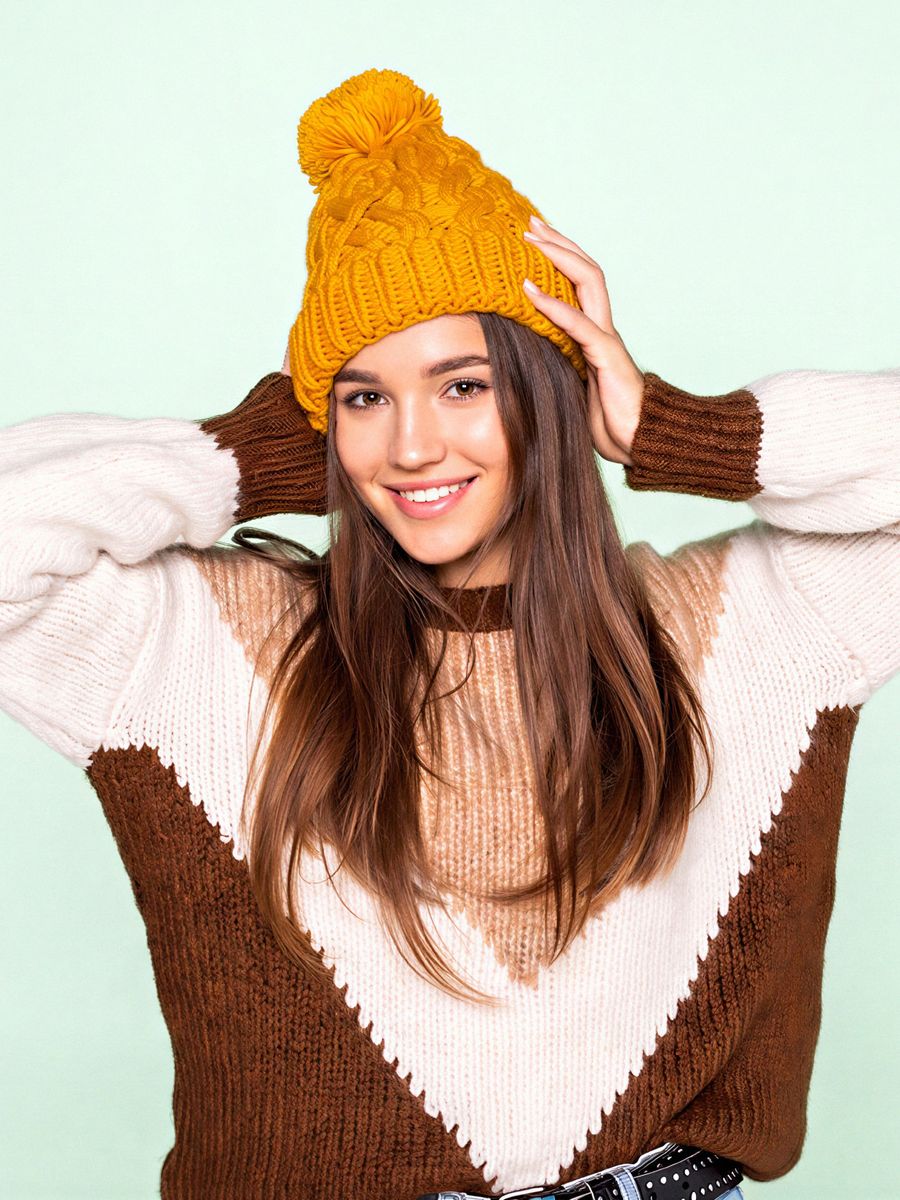
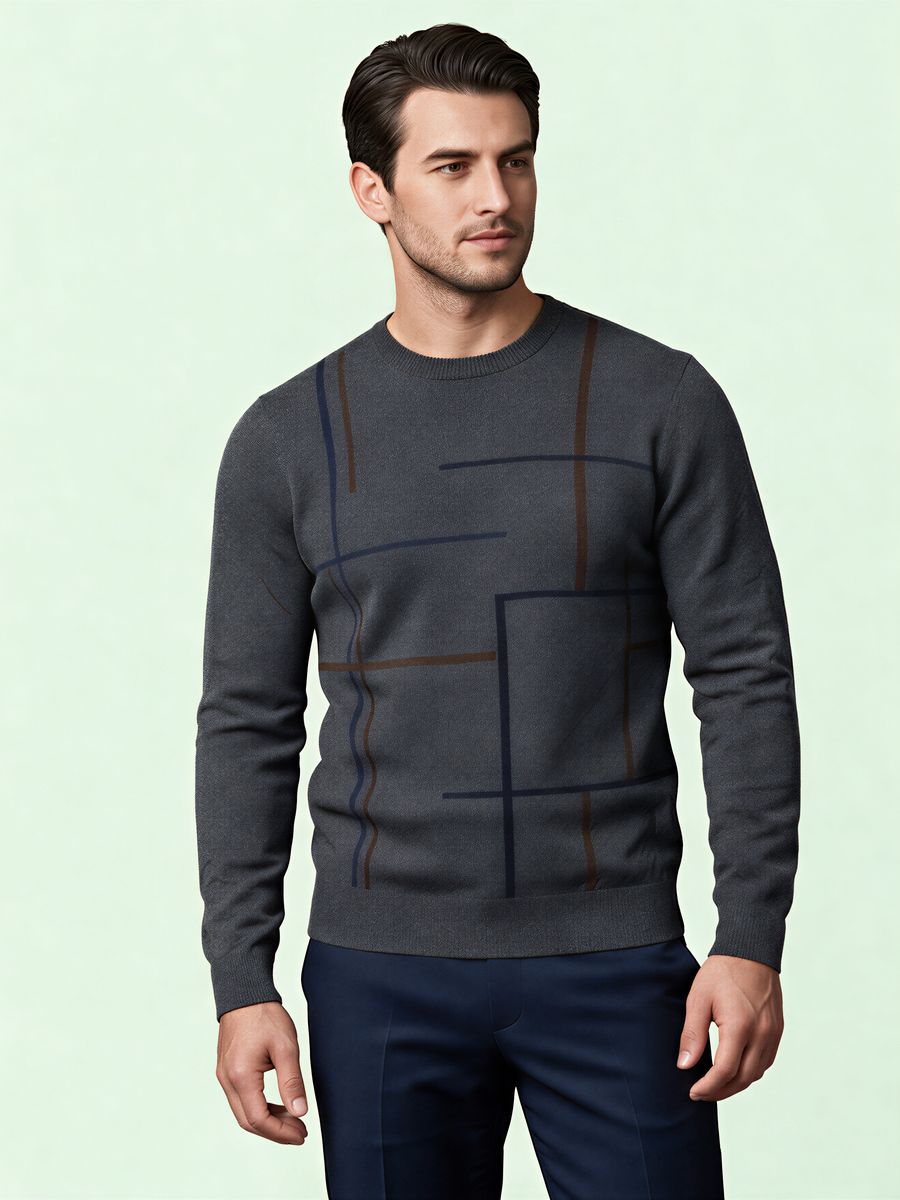
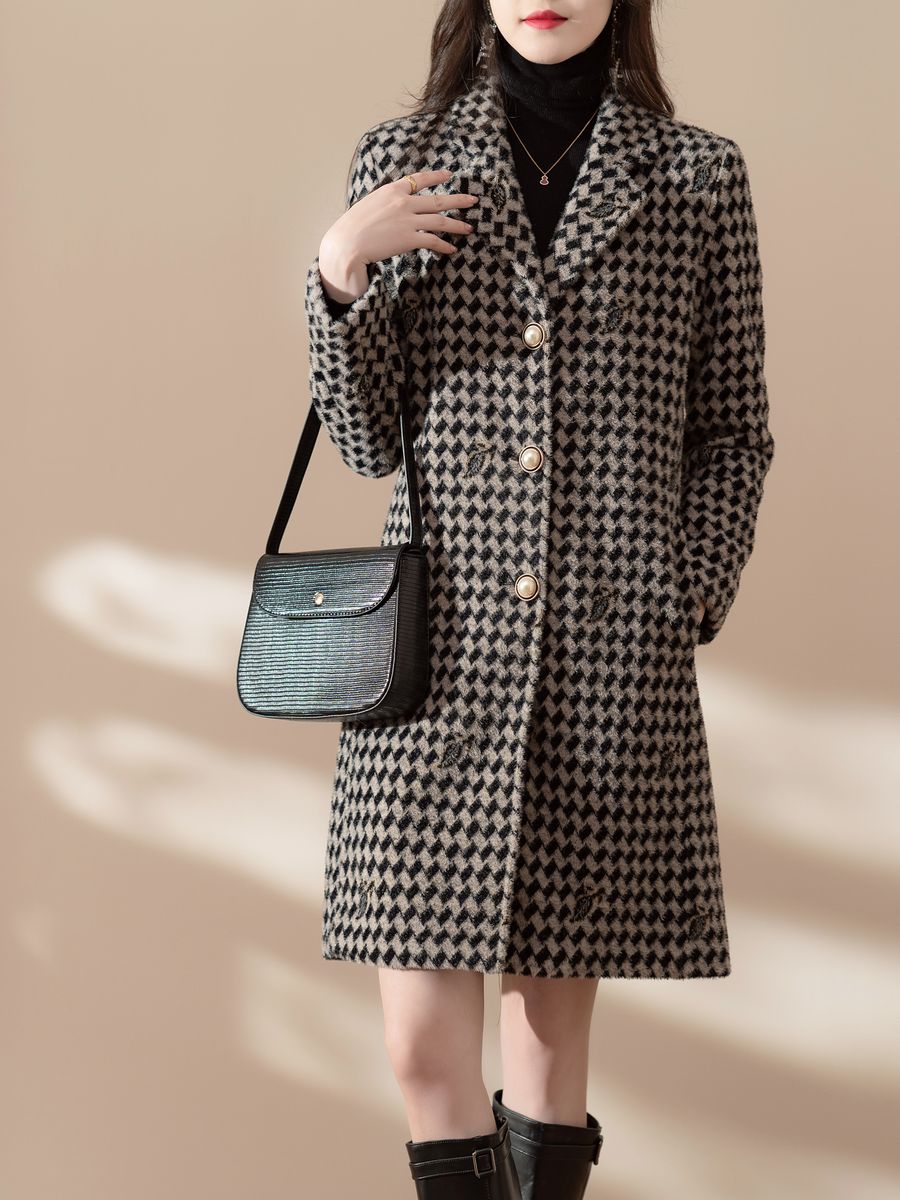
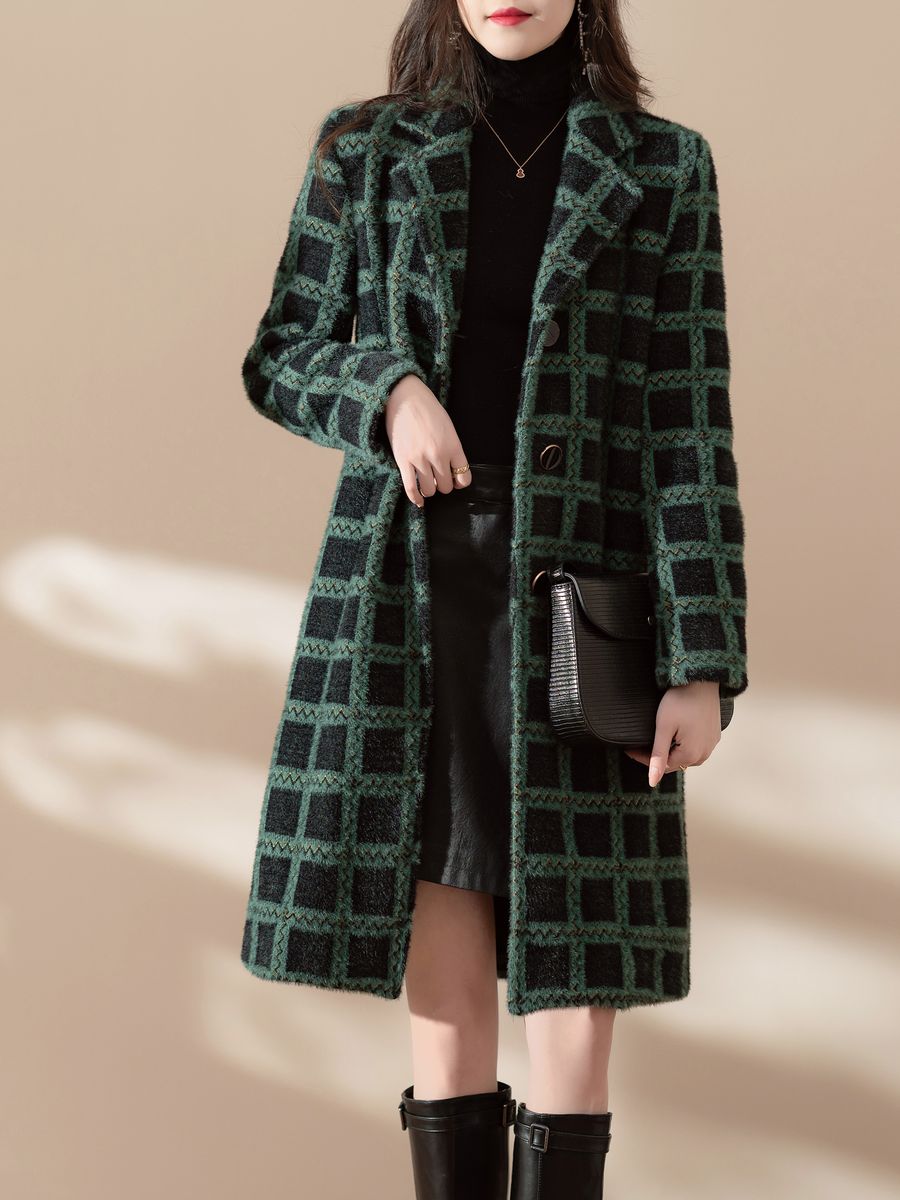
Colour-block, intarsia, houndstooth and check patterns from our production.
Artwork
Prepare artwork that can be knitted.
A knitted pattern is built from solid colours placed stitch by stitch. That changes what a design file can and cannot do.
- No gradients or photos. Gradients, shadows, photos and blended colour transitions cannot be knitted directly. They have to be redrawn as flat colour areas. If the effect depends on a gradient, print or embroidery is usually the better technique.
- File colours are not knit colours. The number of colours in your file is not automatically the number we can knit. We redraw the artwork on the stitch grid of the chosen gauge, then confirm the practical colour count with you.
- Gauge sets the detail. Fine lines and small text can disappear on coarse gauges. The finer the gauge, the more detail a motif can hold.
- Colours add weight. Every added jacquard colour makes the fabric heavier, which affects hand-feel, unit cost and shipping weight.
What to send with your artwork
- Vector or high-resolution artwork
- Pantone references and the yarn composition you have in mind
- Size and placement on the garment: front, back or sleeves
- Your preferred construction, or ask us to recommend one
- Target market, quantity per colourway and target price
From artwork to bulk
How a jacquard sweater moves through development.
Review
Construction, colour count, placement and yarn are agreed.
Program
The artwork is redrawn on the stitch grid and programmed for the machine.
Swatch
A knitted swatch, ready 2–3 days after we receive the artwork, checks scale, colour balance and floats.
Sample & wash
The sample is washed to check shrinkage and pattern distortion.
Approve
Approved swatch, sample and washed sample become the bulk standard.
A knitted jacquard swatch is normally ready 2–3 days after we receive your artwork. Once the swatch is approved, we knit the garment sample: plain-knit samples normally take 3–5 days, and multi-colour jacquard and intarsia can need some extra programming time. We confirm the timing when we review your artwork.
Real example: see how one buyer’s reference picture became a scallop jacquard top and skirt sample, in their own colours, on our jacquard knitwear page →
Avoid these mistakes
Common mistakes in jacquard development.
These are the problems we see most often when brands develop patterned knitwear for the first time. Most of them can be prevented before the first sample.
Construction
- Ordering float jacquard for a next-to-skin sweater, then finding long floats on the inside.
- Expecting a double jacquard to show the same image on both sides.
- Expecting jacquard to be as light and thin as a print. Double jacquard is heavier and thicker.
- Not specifying tacking for long floats. Untacked floats snag and pull after washing.
Colour
- Approving Pantone numbers without lab dips on the actual yarn. Sweater yarn is dyed before knitting, so colour is harder to correct later than in printing.
- Forgetting that fibres take dye differently. The same Pantone can look different on cashmere, cotton and nylon within one pattern.
- Approving colours from a small sample dye lot without checking the bulk lot. Small differences become obvious when colours sit side by side.
- Leaving colour tolerance unwritten. Agree the standard, for example grey scale grade 4 or 3.5, before bulk.
Fit and shrinkage
- Reusing a plain-knit pattern for a jacquard style. Jacquard stretches less, so the garment comes out smaller and tighter.
- Skipping the washed sample. Different coloured yarns can shrink differently, which twists checks and moves motifs out of line.
- Ignoring stitch density. Too open and the pattern looks thin; too dense and the garment becomes stiff, heavy and expensive.
Cost, minimums and lead time
- Budgeting a five-colour pattern like a two-colour one. Programming, machine set-up and trial knitting increase with every colour.
- Counting minimums on the total order. Each pattern and colourway is set up separately on the machine, so minimums apply per colourway.
- Planning jacquard sampling like a plain knit. Jacquard adds a swatch stage before the garment sample, so allow extra development time, especially in peak season.
- Not checking the inside of bulk garments. A construction quietly changed to cut cost, such as double jacquard replaced by single jacquard, shows on the back of the fabric.
Quality
- Pattern not matched across front, back and sleeves, or at the neckline and shoulder seams.
- Dropped stitches, missed yarns or wrong colours where yarn carriers change.
- Float backs not tested for snagging before bulk.
- Pilling not tested when different yarns are knitted together.
- Dark colours bleeding into light areas because colour fastness was not agreed.
Approvals and contracts
- Approving only the look of the sample, without a knitted swatch and a washed sample.
- Agreeing construction verbally. Birdseye back, tacking and intarsia areas belong on the tech sheet.
- Not asking where bulk will be knitted. Sampling in one factory and bulk in an unaudited workshop is a common source of quality problems.
- Leaving pattern ownership open. Agree who owns the artwork and machine program, and whether the pattern may be offered to other customers.
Checklist
Jacquard order checklist.
Copy this list into your tech pack or send it with your inquiry.
- Construction: double jacquard (birdseye back), single jacquard (float back) or intarsia
- Number of colours, Pantone references and yarn composition, confirmed with lab dips and yarn colour cards
- Float rules: maximum float length in needles, and whether long floats are tacked
- Performance: stretch, shrinkage, washing method, pilling grade and colour fastness
- Approval samples: knitted swatch, first sample and washed sample
- Pattern placement tolerance and matching at seams
- Programming and set-up fees, minimums per colourway, and charges for changing colours or patterns
How we handle jacquard projects
Our in-house design team reviews your artwork free of charge, recommends the construction and colour count, and redraws the motif for the chosen gauge. We knit 3GG to 16GG on computerized flat knitting machines, and washing and finishing happen in our own factory, so the washed result can be checked before bulk. OEM artwork stays confidential, and we are happy to sign an NDA or reserve a pattern exclusively for your brand.
See our jacquard knitwear capabilities →
How sampling works →
Start a project