Yarn guide
Certified Yarns for Knitwear: GRS, RWS, OCS and GOTS.
Recycled and responsibly sourced yarns are now a standard request from brands. Each certificate proves something different, and each adds paperwork, lead time and minimums. This guide explains what the main yarn certifications cover, which documents to ask for, how certified yarn affects MOQ and cost, and what changes as Textile Exchange moves to its new Materials Matter Standard.
 By Marcia Lee, Business Manager at Knitwear World · Updated October 2026
Start with the claim
Which certificate proves what.
Start with the claim you want to make on the product or in your sustainability report, then choose the certificate that supports it. A recycled-content claim, a wool welfare claim and an organic claim each need a different standard.
| Certificate | What it covers | Typical knitwear yarns | What we can supply |
|---|---|---|---|
| GRS (Global Recycled Standard) | Recycled content tracked through the supply chain, plus social, environmental and chemical requirements at certified sites | Recycled polyester, recycled cotton, recycled acrylic and blends | GRS yarns with GRS certificates; a transaction certificate (TC) can be applied for each order |
| RWS (Responsible Wool Standard) | Animal welfare and land management on wool farms, with chain of custody to the finished product | Merino wool and wool blends | Certified, traceable RWS merino |
| OCS (Organic Content Standard) | Organic fibre content, tracked from farm to finished product | Organic cotton | Can be arranged |
| GOTS (Global Organic Textile Standard) | Organic fibre plus environmental and social criteria for processing, including dyeing and chemical use | Organic cotton | Can be arranged |
How much certified fibre is enough?
Each standard sets a minimum share of certified fibre, and consumer-facing labels need a higher share than business-to-business documents.
- GRS: products with at least 20% recycled content can be handled under GRS between businesses; consumer-facing GRS labelling needs at least 50%.
- GOTS: at least 95% certified organic fibre for the “organic” label grade, and 70–94% for “made with x% organic materials”.
If your yarn is a blend, for example recycled polyester with conventional acrylic, check the recycled share before you design the hangtag.
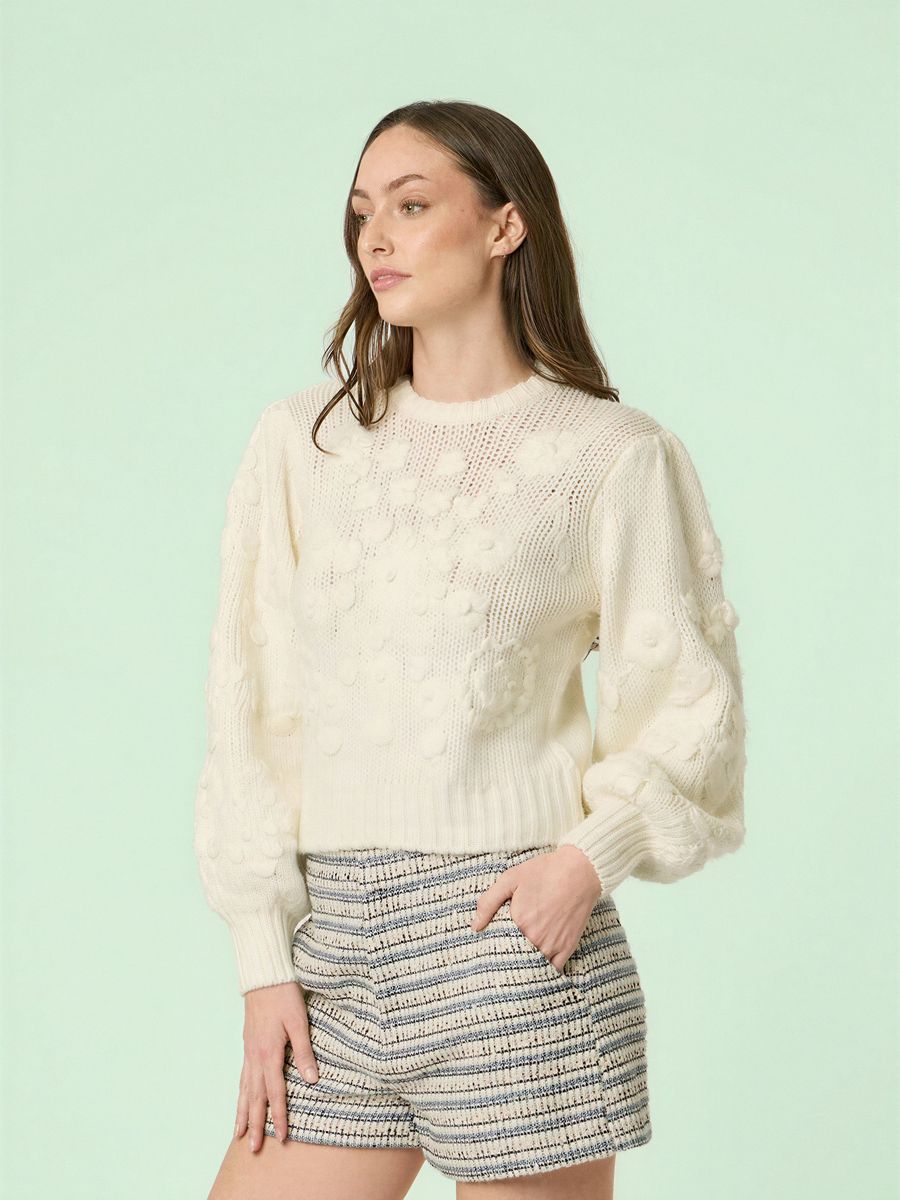


Sweaters from our production. Ask us which of our yarns are available in a certified version.
Paperwork
Scope certificates and transaction certificates.
Two documents do different jobs, and buyers often ask for the wrong one.
- Scope certificate (SC). Shows that a company is certified for certain products and processes. Check that it is valid and that it covers the yarn type you are buying.
- Transaction certificate (TC). Covers a specific shipment of certified goods. Retailers and brands that make on-product claims usually need a TC for each order.
A TC is applied for per order through the certified supply chain and issued by a certification body, so it takes time and adds a certification fee. Tell us at the quotation stage if your order needs one. We then buy the yarn from certified stock and plan the paperwork into the lead time, instead of trying to add it after shipment.
Ask for documents, not adjectives. “Eco”, “sustainable” and “recycled” on a yarn card prove nothing. Ask for the certificate, check it in the certification body’s or standard owner’s public database, and keep a copy with the order.
MOQ and cost
How certified yarn affects minimums and cost.
Certified yarns are often dyed to order. Yarn mills commonly dye in minimum lots of 25, 50 or 100 kg per colour, depending on the mill and the yarn. A sweater uses roughly 0.2–0.4 kg of yarn, so:
| Mill lot | Sweaters per lot (approx.) | What it means for you |
|---|---|---|
| 25 kg | 60–125 | Fits a small colourway; at 50 pcs some yarn is left over |
| 50 kg | 125–250 | A 50 pcs colourway leaves much of the lot unused |
| 100 kg | 250–500 | Plan colours across styles, or keep yarn for a reorder |
Our standard MOQ is 300 pcs per style with at least 50 pcs per colour. With certified yarn in a custom colour, the yarn lot can matter more than our MOQ. Leftover yarn can be kept at our factory for a repeat order or shipped to you; either way it is a cost, and we explain it before you confirm the order.
Ways to keep certified orders practical
- Use the mill’s stock colours where they exist, instead of dyeing to order.
- Use the same certified yarn and colour across several styles.
- Plan reorders, so leftover yarn is used rather than written off.
- Allow extra lead time for certified yarn and for the TC.
What is changing
Textile Exchange is moving to the Materials Matter Standard.
Textile Exchange is bringing GRS, RCS and its animal-fibre standards, including RWS, into one new standard, the Materials Matter Standard. The main dates from its transition policy:
- 31 December 2026: the Materials Matter Standard takes effect, and audits to it can start.
- 31 December 2027: all audits must be conducted to the new standard.
- 31 March 2029: legacy GRS and RWS scopes must be withdrawn; no recertification to them is possible after this date.
- 14 April 2029: certification bodies stop issuing GRS and RWS transaction certificates.
The Organic Content Standard is outside this policy and continues to run in parallel. GOTS is a separate standard: GOTS Version 8.0 was released in April 2026 and is fully effective from 1 March 2027.
What this means for your next orders: GRS and RWS certificates and TCs remain usable during the transition. If you are printing new hangtags or labels with certification logos, confirm your claim wording with your certification body first, because legacy GRS and RWS logos will be phased out in favour of Materials Matter claims.
Checklist
Certified yarn order checklist.
Copy this list into your tech pack or send it with your inquiry.
- Which standard your brand or retailer requires, and whether you need a TC for each order
- Fibre content, and the minimum certified share your claim needs
- The yarn supplier’s scope certificate, checked for validity and yarn type
- Stock colour or dyed to order, and the mill’s minimum lot
- Hangtag and label wording, and logo use, confirmed before printing
- Extra lead time for certified yarn and the TC
- What happens to leftover yarn
How we handle certified yarns
We source GRS recycled polyester, cotton and acrylic, RWS merino, and OCS or GOTS organic cotton through certified yarn suppliers. We provide the certificates, apply for a TC per order when you need one, and test pilling, shrinkage and colour fastness on the certified yarn before bulk, just as we do for conventional yarns.
See our yarn options →
Knitwear MOQ explained →
Sources
Start a project